A conditional lien waiver protects you. An unconditional lien waiver does not. That distinction — two words, "conditional" versus "unconditional" — determines whether you keep your legal right to file a mechanics lien if payment never arrives.
Every monthly draw package requires lien waivers from the GC and every active subcontractor. On a large commercial project with 20+ subs, each carrying 2–5 lower-tier suppliers, that means collecting dozens of waivers per billing cycle. Getting even one wrong can hold up payment for the entire project.
What Lien Waivers Are and Why They Exist
A lien waiver is a legal document in which a contractor, subcontractor, or supplier relinquishes their right to file a mechanics lien against the property for a specified payment amount. Lenders require them because a mechanics lien clouds the property title, can trigger construction loan default, stops future draw disbursements, complicates title insurance, and in extreme cases allows the lienholder to force a sale.
Over 90,000 mechanics liens are recorded annually. Properties with unresolved liens can face value reductions of 25% or more. Lenders are not being bureaucratic when they demand waivers — they are protecting a real financial interest.
The Four Types of Lien Waivers
There are four standard forms, and the draw process uses a specific pair each billing cycle.
Conditional Waiver on Progress Payment
When submitted: With each draw, for the current billing period amount.
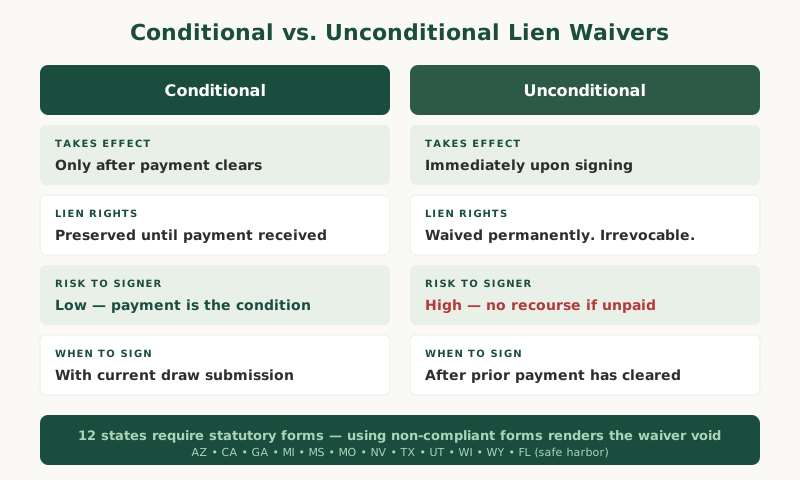
What it does: Waives your lien rights for this payment — but only after payment actually clears. If the check bounces, if the wire never arrives, if the owner goes bankrupt before paying, the waiver never takes effect. Your lien rights survive.
Unconditional Waiver on Progress Payment
When submitted: For the prior billing period, confirming that last month's payment was received.
What it does: Immediately and irrevocably waives your lien rights for the specified amount, the moment you sign it. There is no "undo." No condition. No contingency.
Conditional Waiver on Final Payment
When submitted: With your final pay application at project completion.
What it does: Waives all remaining lien rights — contingent on receiving the final payment.
Unconditional Waiver on Final Payment
When submitted: After final payment has been received and verified in your account.
What it does: Permanently and irrevocably waives every remaining lien right you have on the project.
The Standard Monthly Workflow
Each billing cycle follows the same pattern:
- You submit a conditional progress waiver for the current period's requested amount
- You submit an unconditional progress waiver for the prior period's payment (confirming it cleared)
- At project close, a conditional final waiver accompanies the final invoice
- After the final payment clears your bank, you submit the unconditional final waiver
Your subcontractors follow the same pattern with you. You collect their conditional and unconditional waivers and include them in the draw package.
Conditional vs. Unconditional: The Risk
Here is the thing. The difference between these two documents is not administrative. It is financial survival.
Conditional waivers are safe to sign at the time of billing. The waiver only activates when money hits your account. If payment never arrives, you still hold your lien rights — your legal leverage to get paid.
Unconditional waivers are only safe to sign after payment has cleared your bank. Not when you receive a check. Not when you make a deposit. After it clears. Sign an unconditional waiver before confirming payment, and you have voluntarily surrendered your right to file a lien — even if the check bounces.
Never sign an unconditional waiver until the money is in your account and verified. This is the single most important rule in construction payment law.
State-Specific Requirements: Where Forms Are Mandatory
Twelve states mandate specific statutory lien waiver forms. Using a non-compliant form renders the waiver legally void.
California (Civil Code Sections 8132–8138) has the strictest enforcement nationally. Four statutory forms are mandated. Contractors can be penalized for even requesting non-statutory forms. Adding a notary seal where not required can actually invalidate a waiver in California.
Texas (Tex. Prop. Code Section 53.284) requires strict compliance with statutory forms. Texas also designates construction payments as trust funds under the Construction Trust Fund Act — misapplication carries criminal penalties.
Illinois does not have statutory lien waiver forms, despite what some GCs assume. Court precedent defines enforceable waiver language, but there is no state-mandated form. Illinois does, however, have the most developed Contractor's Sworn Statement requirement in the country.
Other states with mandatory forms: Arizona, Georgia, Michigan, Mississippi (notarization required), Missouri (residential projects only), Nevada, Utah, Wisconsin, and Wyoming (notarization required).
Florida provides safe harbor forms under Fla. Stat. Section 713.20 but permits other forms as well.
If you work across state lines, you need to know the form requirements for every state where you have projects. A valid California waiver is void in Texas and vice versa.
Collecting Waivers from Subs: The Real Headache
Collecting your own waivers is straightforward. Collecting waivers from 20+ subcontractors, each with their own lower-tier vendors? That is where draw packages stall.
The most common problems:
- Late submissions. Subs treat billing as an afterthought. Only 5% of subcontractors are consistently paid on time, with average payment taking 96 days.
- Incorrect amounts. Even a $0.01 discrepancy between the waiver amount and the invoice amount triggers rejection. The industry-wide error rate on lien waivers is staggering — the vast majority arrive with some form of incorrect data before automation tools intervene.
- Wrong type. Subs confuse conditional and unconditional. Or they submit a generic form in a state that requires a statutory form.
- Missing signatures. An unsigned waiver is not a waiver.
- Refusal to sign. Some subs refuse to sign any waivers until paid — particularly in states with pay-if-paid clauses.
- Lower-tier waivers. GCs are responsible for collecting waivers from subs, and subs are responsible for collecting from their own vendors. Lien rights generally exist for the first three tiers.
Resolving Waiver Disputes
When a sub refuses to sign:
- Verify that the pay application amounts match actual work completed
- Offer conditional waivers if the sub objects to unconditional ones
- Allow a "carve-out" — the sub waives the undisputed amount and excludes the disputed portion
- Know that most lenders will not process the draw without all waivers, though some may accept a reduced draw excluding that sub's work
Risks of Getting Waivers Wrong
- Signing unconditional waivers too early: You surrender lien rights for payment you have not received.
- Submitting wrong state forms: The waiver is void. The lender rejects the draw.
- Collecting incomplete sub waivers: One missing waiver from one sub's $3,000 supplier can hold up a $500,000 draw disbursement.
- Not tracking waiver-to-payment reconciliation: Over a 24-draw project, losing track creates a reconciliation mess that delays retainage release.
The piece most likely to be wrong.
Lien waiver accuracy is one of the specific items DrawCheck verifies in every draw package review. Are the correct types submitted? Do the amounts match the invoices? Are the forms compliant with the applicable state's requirements? Are all tiers accounted for?
Waivers are one piece of a larger package — but they are the piece most likely to be wrong, and the piece most likely to delay your payment.
Get Your Draw Checked →Or write to info@drawcheck.co