Every general contractor knows the feeling. The work is done, the subs are calling about payment, and the draw package is sitting somewhere between the architect's desk and the lender's inbox. The construction draw process is the financial engine of every project — and when it stalls, everything downstream stalls with it.
This guide breaks down how draws actually work, who touches them, what goes in the package, and where things fall apart. No theory. Just the mechanics you need to keep money moving.
What Is a Construction Draw?
A construction draw — also called a draw request, pay application, or progress billing — is a formal request for partial disbursement of construction loan funds tied to verified completed work. It is not an invoice. A draw request is a structured package of documents, often 20 to 500+ pages depending on project complexity, submitted by the GC to the lender through the owner.
Here's a distinction that trips people up: a "draw" releases funds from the lender, while a "pay application" requests payment from the owner. On lender-financed projects, both systems run in parallel. You submit a pay application to the owner. The owner submits a draw request to the lender. The lender releases funds to the owner, who pays you, and you pay your subs.
Commercial projects typically run 12 to 24+ draws over their lifespan, billed monthly against a percentage-of-completion schedule. Residential construction loans work differently — 5 to 7 total draws tied to defined milestones like foundation, framing, rough-in, drywall, trim, and final.
The Draw Cycle, Step by Step
The cycle repeats every billing period. Here is what it looks like when it works:
Step 1: Work gets done. Your crews and subs perform work during the billing period. You track percentage of completion against the Schedule of Values.
Step 2: You compile the draw package. This means updating the G703 continuation sheet, completing the G702 cover page, gathering subcontractor invoices and lien waivers, assembling sworn statements, pulling current insurance certificates, documenting change orders, and taking progress photos. On a project with 20+ subs, each with their own vendors, you could be collecting 50 to 100+ lien waivers alone.
Step 3: Architect certification. The architect reviews the G702/G703, verifies the work claimed matches what they've observed, and certifies the payment amount per AIA A201.
Step 4: Owner review. The owner (or their representative) reviews the certified package and forwards it to the lender.
Step 5: Lender review. The lender checks every document, cross-references amounts against the approved budget, orders a third-party inspection, and obtains a title endorsement confirming no new liens have been filed.
Step 6: Disbursement. If everything checks out, funds flow from lender to owner to GC to subcontractors.
Simple in concept. Brutal in execution.

Timeline: How Long Does a Draw Take?
On a clean submission with no issues:
- Package assembly and sub documentation collection: 3–5 business days
- Lender review and approval: 5–7 business days
- Payment disbursement after approval: 1–3 business days
- Total end-to-end: 9–13 business days
With digital platforms, some lenders compress this to 2–4 business days. With a rejection and resubmission? Add 1 to 6 weeks.
The average contractor waits 83 days from work completion to payment receipt. That number should bother you. The healthy target is 45 days, and construction has the longest days-sales-outstanding of any industry.
Every Party Involved (and What They Actually Do)
The draw process touches more hands than most GCs realize when they're starting out.
General Contractor: Prepares the draw package, collects sub documentation, submits to the architect/owner, and distributes funds after receipt. You own the package.
Subcontractors: Submit invoices and lien waivers to the GC. On prevailing wage projects, add certified payroll to that list. One sub's missing waiver can hold up payment for every other sub on the project.
Owner/Developer: Reviews and approves the pay application, then submits the draw request to the lender.
Architect: Reviews and certifies the amount due. Their signature on the G702 tells the lender that the work claimed has been performed.
Lender: Reviews documentation, orders inspections, verifies budget compliance, and disburses funds. They are the final gatekeeper.
Title Company: Provides endorsements at each draw confirming no new liens or encumbrances. They run a "later date search" before every disbursement. If a lien has been filed, they will not authorize the draw until it is resolved or bonded off.
Draw Inspector: A neutral third party hired by the lender who visits the site to verify that claimed progress matches reality. Commercial inspections run $250–$500 each.
Fund Control Company: On some projects, a third-party firm manages and verifies fund disbursements. Common with private or hard money lenders who lack in-house construction loan expertise.
What Goes in the Draw Package
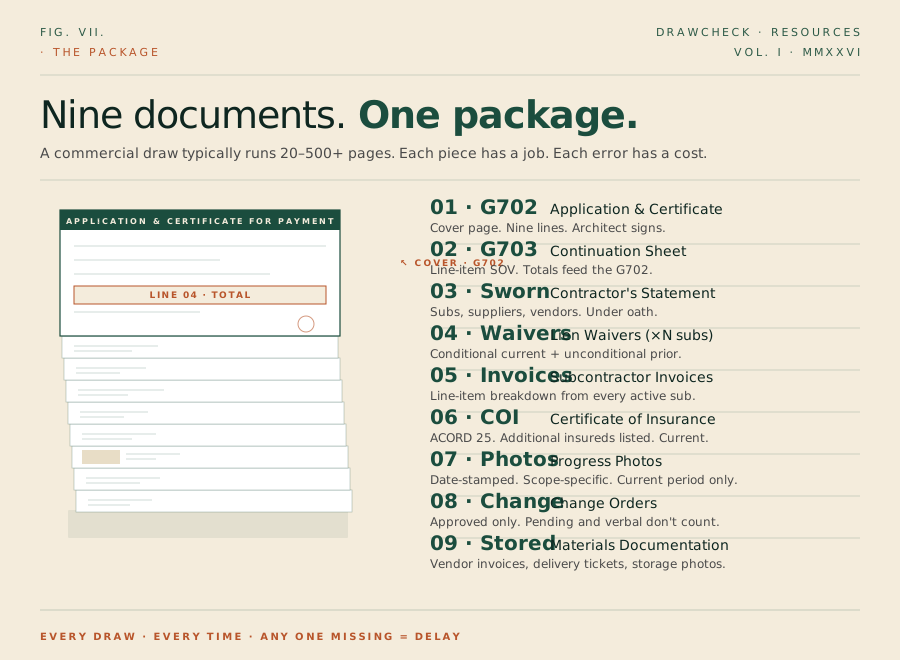
The core documents — every draw, every time:
- AIA G702 — Application and Certificate for Payment. The one-page cover sheet with nine critical lines summarizing the contract amount, completed work, retainage, previous payments, and current amount due.
- AIA G703 — Continuation Sheet (Schedule of Values). The line-item breakdown behind the G702. Totals on the G703 must exactly match Line 4 of the G702. Any mismatch triggers automatic rejection.
- Contractor's Sworn Statement — A legal document (AIA G907) signed under oath listing every subcontractor, supplier, and vendor with exact dollar amounts. Providing false information is a criminal offense.
- Lien Waivers — Conditional progress waivers for the current period plus unconditional progress waivers for the prior period from all active subs. More on the conditional vs. unconditional distinction.
- Subcontractor Invoices — Detailed line-item breakdowns from every active sub.
- Certificates of Insurance — ACORD 25 forms showing current coverage with the GC and owner named as additional insureds.
- Progress Photos — Date-stamped, covering specific scope items billed in the current period.
- Change Orders — Only approved change orders can be included. They appear as separate line items on the G703.
- Stored Materials Documentation — If billing for materials not yet installed: vendor invoices, delivery tickets, photos, and for off-site storage, insurance certificates and bonded warehouse documentation.
For a deeper dive on the G702 and G703 specifically, see our AIA form guide.
Common Pitfalls That Delay Draws
Incomplete submissions are the number one cause of draw delays. Not disputes about work quality. Not disagreements about scope. Paperwork.
Math errors. G703 totals that don't match the G702 summary. Retainage calculated at 5% when the contract specifies 10%. A budget of $500,000 with a first draw of $150,000 showing $360,000 remaining instead of $350,000. These get caught immediately.
Missing lien waivers. One sub's missing conditional waiver can hold up the entire draw. Before automation tools existed, 85% of lien waivers were returned with incorrect data. The problem is better now, but far from solved.
Overbilling. If your G703 says electrical rough-in is 100% complete but the draw inspector sees outlet boxes not installed and wiring incomplete at 70%, the draw gets rejected or revised downward. The inspector works for the lender, not for you.
Document mismatches. Every number must reconcile across every document — G702, G703, sworn statement, invoices, and waivers. Duplicate invoices across draw periods get flagged by lender platforms.
The small stuff. Wrong project address ("St." vs. "Street"). Expired notary commissions. Missing signatures. Wrong draw number references. Individually minor. Collectively, they account for the majority of rejections.
We cover the full list of rejection causes — and how to self-audit before submitting — in Why Draw Requests Get Rejected.
The Real Cost of Getting It Wrong
A rejected draw adds a minimum of 1–2 weeks to the payment cycle. Nearly half of construction professionals report that late payments add 1–2 weeks to their projects, and almost 30% say the impact is 3–6 weeks.
The financial cascade is severe. 95% of GCs float payments while waiting for disbursements. Average GC net income before tax is approximately 6.9% — a few percentage points of carrying cost on a delayed draw can eat the project's entire profit margin. Meanwhile, 86% of subcontractors cover labor expenses out of pocket while waiting, and one in three pulls from personal or retirement savings.
Beyond money, there is reputation. 100% of subcontractors now consider a GC's payment reputation when deciding whether to bid. Two-thirds have walked away from projects because of a GC's slow-pay history.
How to Keep Your Draws Clean
The draw process rewards preparation and punishes improvisation. A few practices that separate GCs who get paid in 10 days from those who wait 83:
- Set sub billing deadlines 7–14 days before your own submission date. If you submit on the 25th, subs submit by the 15th. Exclude late subs from the current draw — they will only be late once.
- Cross-check every number. G702 to G703. Sworn statement to invoices. Waiver amounts to invoice amounts. If one number is off by a dollar, fix it before the lender finds it.
- Use a submission checklist. Treat it like a pilot's pre-flight checklist. Every document, every signature, every notary stamp verified before the package leaves your office.
- Track retainage meticulously. Rounding inconsistencies in month two become reconciliation nightmares in month six.
- Keep insurance certificates current. An expired cert that nobody noticed will stop a draw cold.
Let someone else catch the errors.
The construction draw process is not complicated in theory. It is demanding in practice — a 20-to-500-page package where one wrong number, one missing signature, or one expired certificate can delay payment by weeks. Most GCs know their trade better than they know their paperwork. That gap costs real money.
Before your next draw submission, consider having the package reviewed by someone whose entire job is catching the errors that get draws kicked back. That is what we do at DrawCheck — a second set of eyes on your draw package before it reaches the lender.
Get Your Draw Checked →Or write to info@drawcheck.co