Retainage is straightforward in principle. The owner withholds a percentage of each progress payment as security until the project is finished. You do the same to your subs. Everyone gets their held-back money at the end.
In practice? Retainage math drifts. Rounding errors compound. The percentage changes mid-project and somebody applies it retroactively when they should not. By month six, nobody's numbers agree, and the draw gets kicked back while three people try to reconcile spreadsheets that should have matched from the start.
What Retainage Is
Retainage — also called retention or holdback, depending on where you work — is a contractually specified percentage of each progress payment withheld until the project reaches substantial or final completion. It flows down through the payment chain: the owner withholds from the GC, the GC withholds from subs, and subs may withhold from their sub-subs.
The purpose is risk mitigation. It gives the owner leverage to ensure defects get corrected, punch list items get completed, and the contractor stays motivated through the end of the project.
Typical Retainage Percentages
5% is increasingly the standard on larger commercial projects and in states with statutory caps.
10% remains common on smaller projects, residential work, and in states without caps.
Many contracts — and several state laws — reduce retainage at the 50% completion mark. Alabama, Georgia, Michigan, and North Dakota, among others, stop additional retainage withholding after 50% completion if work is satisfactory.
New Mexico prohibits retainage entirely for most projects — the most aggressive stance of any state.
One rule is consistent nearly everywhere: a contractor cannot withhold a higher retainage percentage from subs than the owner withholds from the contractor. If the owner holds 5%, you hold 5%. Not 10%.
How Retainage Appears on AIA Forms
On the G702, retainage shows up as:
- Line 5a: Retainage on completed work
- Line 5b: Retainage on stored materials
On the G703 continuation sheet, Column I tracks retainage at the line-item level when variable retainage is permitted.
A Calculation Example: Three Draws
Mechanical scope. Scheduled value: $300,000. Contract retainage: 10%, reduced to 5% after 50% completion.
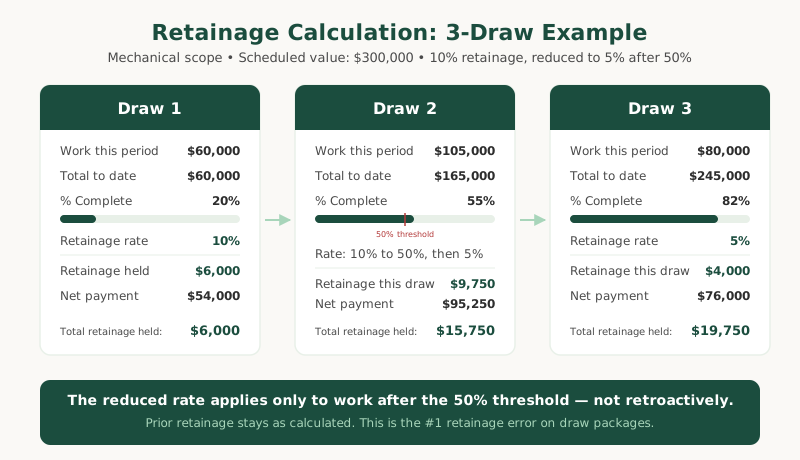
Draw 1: $60,000 work completed (20%). At 10% retainage, $6,000 is held. Net payment: $54,000.
Draw 2: $105,000 work this period, total to $165,000 (55%). The line item crosses the 50% threshold. The first $90,000 of this period's work (to reach the $150,000 / 50% mark) is retained at 10%. The remaining $15,000 is retained at 5%. Retainage this draw: $9,750. Total held: $15,750.
Draw 3: $80,000 work this period, total to $245,000 (82%). All new work at 5%. Retainage this draw: $4,000. Total held: $19,750.
The 5% rate applies only to work performed after reaching 50%. It does not apply retroactively. The $6,000 already held from Draw 1 stays at $6,000.
Fix retainage math in Draw 1. Do not discover the problem in Draw 15.
Common Retainage Errors
These are the mistakes that create reconciliation problems and trigger draw rejections.
- Retroactive recalculation. When the retainage percentage drops at the 50% mark, someone recalculates all prior retainage at the new rate. Wrong. The new rate applies only to work completed after the threshold.
- Rounding that compounds. A rounding inconsistency in month two becomes a reconciliation problem in month six. Carry retainage to the penny.
- Not applying retainage to stored materials. Line 5b on the G702 exists for a reason.
- Not applying retainage to change order line items. Change orders are part of the contract. They get retainage like every other line item.
- G702/G703 retainage mismatch. Line 5a on the G702 must match the sum of retainage across all G703 line items.
- Withholding more from subs than the owner withholds from you. Many states prohibit this. It is a contract violation in most jurisdictions.
The Retainage Release Process
Retainage releases at substantial completion or final completion, depending on the contract. Release requires:
- Certificate of Substantial Completion (AIA G704)
- Final unconditional lien waivers from all parties
- Completed punch list sign-off
- As-built drawings
- Operations and maintenance manuals
- Equipment warranties
- Contractor's Affidavit of Release of Liens (AIA G706A)
- Consent of Surety to Final Payment (AIA G707)
- Certificate of Occupancy
Missing any of these delays retainage release. Some states impose penalties for improper withholding — California charges 2% per month (24% annually) on improperly withheld retention.
Why Retainage Errors Cause Draw Rejections
Lenders verify retainage compliance at every draw because it directly affects their security position. If retainage calculations do not reconcile between the G702 and G703, the lender rejects the draw for correction.
On a 20-draw project, retainage errors that go uncorrected in early draws create a cascading reconciliation problem that becomes harder to fix with each subsequent submission. Fix retainage math in Draw 1. Do not discover the problem in Draw 15.
Small errors compound into large ones.
Retainage math is one of the specific items DrawCheck reviews in every draw package. Correct percentage applied. Stored materials retained. Change orders retained. No retroactive recalculation errors. G702 and G703 retainage totals reconciled.
Small errors in retainage become large problems over time. We catch them early.
Get Your Draw Checked →Or write to info@drawcheck.co